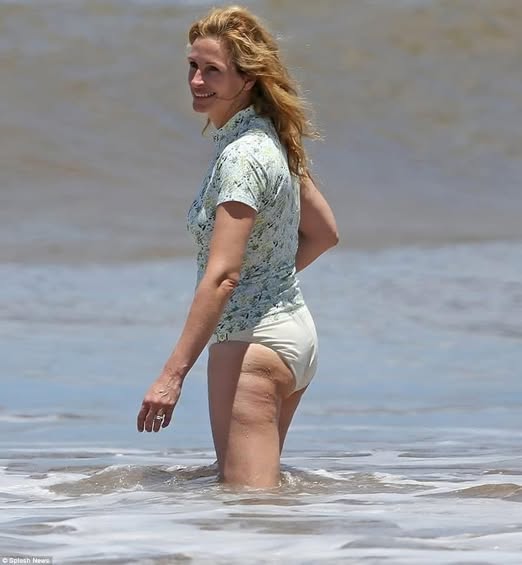
Julia Roberts, one of Hollywood’s most recognizable and enduring figures, recently found herself at the center of a public debate after sharing a personal, unedited photo online. The image, taken casually at home with her niece, showed the 56-year-old actor without makeup, professional styling, or digital retouching. What appeared to be a simple family moment quickly sparked widespread online reaction, including harsh and personal criticism about her appearance.
Roberts, whose career spans more than three decades and includes some of the most successful films in modern cinema, has long been admired for her distinctive smile and expressive on-screen presence. Her decision to post an unfiltered image stood in contrast to the highly curated content typically shared by public figures, particularly women in the entertainment industry.
The response, however, was immediate and polarized. While many followers expressed appreciation for the candid moment, others posted comments that focused on her looks rather than the context of the photo. Some remarks compared her appearance to a man, while others described her as “ugly” or claimed she had “aged badly.” The intensity and volume of the criticism drew attention well beyond her social media page and prompted broader discussion about online behavior and beauty standards.
Roberts later addressed the comments directly, acknowledging their impact and questioning the culture that enables such responses. “They say I look disgusting, that I’ve aged poorly, and even that I look like a man,” she wrote. “Before, no one knew what fools were thinking. Now everyone feels entitled to say it out loud.” She followed with a pointed question that resonated with many readers: “Why should we tolerate this?”
Her remarks highlighted a growing concern shared by public figures and private individuals alike—the normalization of cruelty in online spaces. While social media platforms are often framed as tools for connection and self-expression, critics argue that they have also lowered barriers to personal attacks, particularly against women and older individuals.
The reaction to Roberts’ photo quickly expanded into a larger conversation about ageism, misogyny, and unrealistic beauty standards. Observers noted that male actors are rarely subjected to the same level of scrutiny as their female counterparts when they age naturally. Lines, wrinkles, and gray hair are often described as signs of experience or distinction in men, while women are frequently criticized for the same traits.
Support for Roberts also arrived in significant numbers. Thousands of fans posted messages praising her authenticity and rejecting the negative commentary. One supporter wrote, “She is a beautiful woman,” adding that audiences have become unaccustomed to seeing faces without cosmetic enhancements or digital editing. Another commented, “People no longer understand natural beauty without plastic surgery and Photoshop.”
Others emphasized that aging is an unavoidable and natural process, not a personal failure. Many described Roberts’ photo as refreshing in a digital environment dominated by filters, retouching, and carefully managed public images. For these supporters, the image represented confidence rather than defiance.
The incident has also drawn attention to the pressures faced by women in the public eye, particularly those over 40. Industry analysts have long noted that actresses often encounter diminishing roles and heightened appearance-based criticism as they age, while male actors continue to find leading opportunities well into later life. Social media, critics say, has intensified these dynamics by providing constant, unfiltered access to public opinion.
Psychologists and media researchers suggest that such reactions are partly driven by shifting expectations of perfection. Daily exposure to edited images—whether from celebrities, influencers, or advertising—can distort perceptions of what is normal. When a well-known figure deviates from those expectations, it can provoke discomfort or backlash.
Roberts’ career itself offers context to the moment. She rose to fame in an era before social media, when public images were mediated through films, interviews, and professionally staged photo shoots. Over time, she has spoken openly about prioritizing family life and maintaining boundaries between her work and private world. The decision to share a personal, unpolished image aligns with that long-standing approach.
While Roberts did not indicate that she would change how she presents herself online, her comments underscored the need for accountability in digital interactions. The episode has prompted renewed calls from advocacy groups and commentators for more respectful discourse, particularly when discussions involve appearance, gender, or age.
The broader significance of the moment lies not in a single photograph, but in what it reveals about cultural attitudes. A natural, makeup-free image from a globally recognized actor became a catalyst for examining how society responds to authenticity—and how quickly judgment can replace empathy.
For many observers, Roberts’ response reframed the conversation. By addressing the comments directly rather than ignoring them, she highlighted the human impact of online criticism. Her words served as a reminder that public figures are not immune to the effects of repeated negative commentary.
As discussions continue, the incident stands as an example of the challenges that come with visibility in the digital age. It also raises enduring questions about how beauty is defined, who gets to define it, and whether social media users are willing to reconsider the tone and substance of their public judgments.
In choosing to share an unfiltered moment and to speak candidly about the reaction, Roberts added her voice to an ongoing debate about authenticity, respect, and responsibility online—one that extends far beyond Hollywood and touches anyone navigating public life in an increasingly connected world.