
Anyone who wears glasses or has ever strained to spot something in the distance knows how easily the eyes can be fooled. Even people with perfect vision experience moments where a scene doesn’t immediately make sense. A shadow looks like an animal, a reflection seems like a doorway, or an angle turns an everyday object into something unrecognizable. These moments of visual confusion, while brief, are strangely delightful — and an entire online community is dedicated to collecting them.
The Confusing Perspective subreddit has become one of the internet’s most entertaining archives of optical surprises. With millions of contributors and viewers, the group celebrates photographs that, at first glance, appear impossible. Only after a second (or third) look do the real shapes and relationships reveal themselves.
Below is a closer look at why these images are so compelling, how forced perspective works, and why our brains fall for these visual tricks so easily.
When Ordinary Scenes Become Optical Puzzles

Many of the photos shared in the community are completely ordinary moments: a bedspread, a hallway after rain, a pet relaxing on the floor. Yet when captured from just the right angle, these everyday scenes suddenly appear surreal.
A crocheted blanket looks like a series of deep wooden boxes.
A dog blends so perfectly into a patterned cushion that its body seems to disappear.
A group of small toy figures looks convincingly life-sized until a household cat wanders into the frame.
These illusions don’t rely on editing. They are simply examples of how perspective and context can transform a simple photograph into something unexpectedly puzzling.
Why Forced Perspective Fascinates Millions
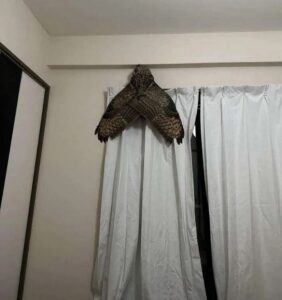
The subreddit emphasizes an important distinction: it is not about objects that resemble something else by coincidence (a rock that looks like a face, for instance). Instead, the focus is on forced perspective — a photography technique that manipulates angles, distance, and alignment to change how we perceive size and depth.
Anyone who has taken a tourist photo “holding up” the Leaning Tower of Pisa or “pinching” the top of a mountain already knows how forced perspective works. The technique relies on:
• placing one object close to the camera and another far away
• aligning their edges precisely
• using a narrow focal point to merge them visually
The result is an image that defies expectations, even though nothing in it has been altered.
Film Directors Have Used This Technique for Decades
Toy figures in a Jeep with a cat and dinosaur create a confusing perspective scene.
While online communities share forced-perspective photos for fun, filmmakers have relied on the technique to solve complex storytelling challenges.
One of the most famous examples is The Lord of the Rings trilogy. Director Peter Jackson used forced perspective extensively to make average-height actors appear as hobbits. Instead of digital effects, many shots used clever distance placement:
• actors portraying hobbits sat much farther from the camera
• props were built at multiple scales
• camera angles were chosen to hide the spacing differences
The result fooled audiences so effectively that many assumed the visual effect was digital.
Architecture Uses Optical Illusion, Too
Graffiti-covered hallway reflecting in water, creating a confusing perspective.
Forced perspective isn’t limited to photography and film — even buildings can employ it.
At Disneyland, the iconic castle appears taller and grander thanks to a subtle trick: each upper floor is built at a smaller scale than the one below it. Visitors entering the park perceive the structure as monumental, while those walking away experience the opposite — it feels closer and more compact.
Ancient architecture also made use of similar ideas. The Parthenon in Athens features columns with a slight outward curve, and its platform is gently arched. These adjustments counteract natural visual distortions, making the structure appear perfectly straight from a distance.
Our Brains Constantly Guess What We Are Seeing
Confusing perspective image of two hikers, one appearing to wear the other as a backpack, in a scenic outdoor setting.
Optical illusions highlight a deeper truth: the human brain doesn’t simply “see” — it interprets. When light reaches the eyes, the brain must make quick decisions about depth, size, motion, and shadow.
Most of the time, it does so flawlessly. But illusions exploit its shortcuts.
A well-known scientific example is the viral photograph of “the dress,” which some people saw as black and blue and others saw as white and gold. Researchers concluded that the debate came down to different assumptions about lighting conditions. Minds made opposite guesses about whether the dress was in bright light or shadow.
The same principles are at work in confusing perspective photographs. When the angle or lighting removes context, our brains lean on assumptions that may not apply.
Why We Can’t “Unsee” an Illusion Even After Understanding It