Three years ago, my mom was hit in one. A distracted driver. A green light. A body that never walked again.
The wheelchair changed more than her legs. It changed the way she sees herself in rooms. In aisles. In lines.
She hates feeling like she takes up space.
Last week, she said, “I want to go to the store with you.”
I froze with my keys in my hand.
“To Lark?”
She nodded. “I miss picking my own apples, Eli. I miss being normal.”
We chose a weekday morning. Lark Market is our family’s store, but Mom never liked attention. We keep that quiet.
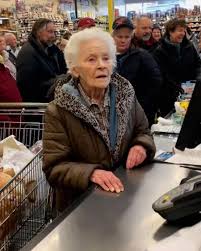
She wore her gray sweater and the scarf she calls her “public armor.” I pushed her slowly, like the tile might shift under us.
We got flour, apples, pecans, butter. For a few minutes, she was herself again.
“Do we have cinnamon?” I asked.
She snorted. “Eli, I have enough cinnamon to preserve a body.”
I laughed.
Then we reached checkout.
Her hands tightened on the armrests. Her jaw locked. The line was short, but being visible drains her in ways I can’t fix.
“Want to rest?” I whispered.
“I came,” she said. “I’m staying.”
That’s when the woman appeared.
Forties. Polished. Heels sharp enough to cut through tile. Her cart was overflowing with champagne, wagyu, caviar—food wrapped like jewelry.
She didn’t look at the line.
She shoved her cart directly into Mom’s wheelchair.
Hard enough to jerk the front wheel sideways.
Mom sucked in a breath.
“Excuse me,” I said evenly. “The line starts back there. My mom’s in pain.”
The woman glanced at the chair. Then at me.
She smirked.
“I’m hosting a gala tonight,” she said, checking her watch. “I don’t have time to wait behind people who take up extra space.”
Extra space.
The words hit like a slap.
The cashier—Maya—froze.
Mom squeezed my wrist. “Let it go,” she whispered.
The woman began unloading her cart like she owned the register.
“Ring me up,” she snapped. “Or I’ll call the owner.”
Maya looked terrified.
Then she leaned down like she was grabbing bags—and winked at me. Her hand tapped something under the counter.
The intercom crackled.
“Attention shoppers and staff. Please direct your attention to register four.”
That was us.
The woman rolled her eyes.
The voice continued, warm and proud.
“Today we’re celebrating my mother’s birthday. If you see Maria near register four, please wish her well. She built this store with her hands and her heart. Happy birthday, Mama.”
The woman stiffened.
Mom’s shoulders curled inward. “Oh no,” she whispered.
The woman snapped into performance mode. “This is harassment. I’m being singled out.”
Then she pointed at Mom.
“Maybe you shouldn’t block aisles with that thing.”
That thing.
My vision went sharp.
“Don’t call her a thing.”
She grabbed champagne and caviar off the belt and shoved them into her bag.
“Some of us contribute to society,” she spat. “Some of you just take.”
And she stormed out.
I took one step after her.
Mom’s hand clamped around my wrist.
“Don’t leave me.”
So I stayed.
In the office, my brother Ben crouched in front of Mom like he could shield her from the world.
“Mama, are you okay?”
“I didn’t want attention,” she whispered.
Maya knocked a moment later, holding a printout.
“She tried to use her loyalty number,” she said. “Name’s Claire.”
Ben’s jaw tightened.
“We ban her,” he said calmly. “We report the theft. We don’t turn Mom into a spectacle.”
Mom just said, “I want to go home.”
That night, I couldn’t sleep. The words extra space echoed in the dark.
At 2 a.m., Ben texted: She’s hosting a gala tomorrow.
We were catering it.
Contract signed. Staff depending on it. We couldn’t cancel without hurting our own people.
So we went.
White tablecloths. Candlelight. Polite laughter. Claire in a sleek dress, smile stretched too tight.
A venue manager rushed up to us. “The refrigeration failed. We’re missing half the spread. Claire is going to lose it.”
Ben didn’t blink. “What do you need?”
“Anything. Thirty minutes.”
We moved fast. Called the store. Emergency platters. Rearranged boards. Filled gaps.
Then Claire spotted us.
Her eyes landed on Mom.
Fear. Then calculation.
She marched over.
“What are you doing here?”
“Delivering,” Ben said evenly.
“This isn’t the time for drama.”
Mom spoke before I could.
“Look at me when you talk about me.”
Claire froze.
“You shoved my wheelchair,” Mom said calmly. “You called me extra space. If you’re sorry, say it.”
Guests were listening now.
Claire tried the easy way out. “I’m sorry if you were offended.”
Mom’s voice didn’t shake. “I didn’t do anything to you. Try again.”
Claire swallowed.
“I’m sorry. I’m sorry I hit your wheelchair. I’m sorry I said you take up extra space.”
Mom held her gaze a moment longer.
“Thank you.”
The room exhaled.
We fixed the food. The gala survived.
Afterward, Ben pulled Claire aside.
“You’re banned from our store,” he said. “You stole. And you assaulted my mother.”
“I can make calls,” she snapped.
“And I can send footage to the police.”
Her face went blank.
She walked away.
The next day, we baked the pecan pie.
Mom’s hands trembled as she measured flour.
“If it’s terrible,” she muttered, “we blame the apples.”
The crust came out uneven. A little dark.
Mom took a bite anyway.
Closed her eyes.
“This,” she said softly, “is worth taking up space for.”
And for the first time since the crosswalk, I saw it.
She wasn’t shrinking.
She wasn’t disappearing.
She was still here.
And she was done apologizing for existing.