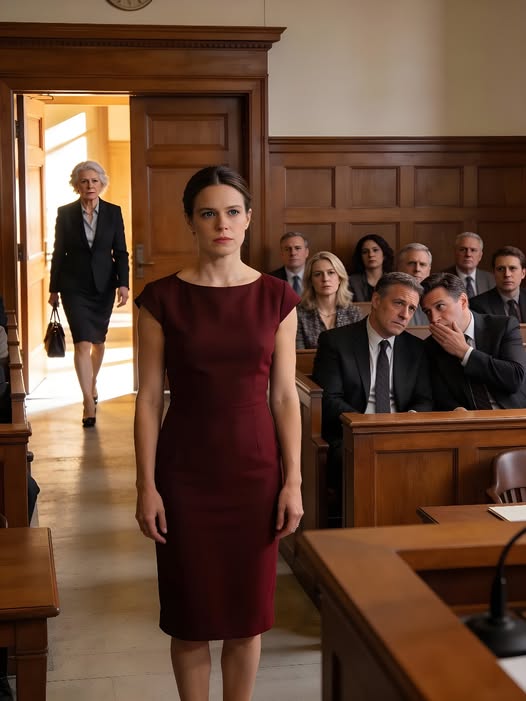
When the judge asked for appearances, Aaron’s lawyer rose with practiced confidence and introduced himself. Then it was my turn.
I stood. Alone.
“No representation, Your Honor,” I said, keeping my voice steady.
A ripple of whispers moved through the benches. Aaron didn’t even try to hide his amusement. He leaned back, arms crossed, wearing an exaggerated look of pity that didn’t reach his eyes.
“No money, no influence, no one backing you up…” he said loudly enough to make sure everyone heard. Then he tipped forward and sharpened his smile. “So tell me, Brianna—who’s going to save you?”
He wanted the room to believe I was powerless.
He expected embarrassment to do the work his lawyer couldn’t.
He assumed standing alone meant I’d already lost.
The words stung, but I refused to react. Aaron had always been good at turning control into a performance. Over twelve years of marriage, he’d tightened his grip in small, calculated ways—nudging me away from work, making friendships inconvenient, turning independence into something I didn’t “need.”
And when I finally asked for a divorce—after discovering his affair—he moved fast. By the next morning, accounts were frozen, access was limited, and the message was clear: he wanted me cornered.
The hearing started, and his attorney laid out their demands like a checklist: the house, most of the assets, and primary custody of our daughter, Chloe. Even the proposed settlement felt designed less to resolve things and more to humiliate me. Aaron watched my face closely, waiting for the moment I’d break.
But panic never arrived.
Standing there without a lawyer wasn’t a mistake—it was the beginning of my plan.
The judge looked at me with the kind of careful patience reserved for people who might ask for more time. I could almost feel the assumption in the room: that I’d miscalculated, that I was unprepared, that I was about to plead for a delay.
I didn’t.
Before I could speak, the courtroom doors opened.
It wasn’t a loud entrance. No dramatic slam, no announcement. Just the soft sound of the door moving—yet it somehow pulled every eye in the room. Conversations died in mid-breath.A woman stepped inside with silver hair and a calm, unwavering presence. She wore a dark suit that looked simple at first glance, until you noticed how perfectly it fit—how it seemed to carry its own kind of authority. She walked with steady purpose, her posture straight, her expression composed.
The judge lifted his head, visibly startled. The air shifted, as if everyone had silently agreed that something important had just entered the room.
Whispers stopped.
Faces turned.
Even the court staff seemed to pause.
Aaron turned toward the doorway—and the color drained from his face. The smug grin he’d worn minutes earlier vanished, replaced by a look that was closer to dread than surprise.
Because in that instant, he recognized her.
He had spent years believing I had no support, no leverage, no one willing to stand beside me. He had assumed that isolating me meant I was truly alone.
But he had never bothered to learn who my mother was.
And now, as she entered the courtroom and the room went still, Aaron seemed to understand something all at once: the story he’d built—his control, his confidence, his carefully protected reputation—was about to unravel.
In the end, he didn’t look like a man who’d won anything. He looked like someone realizing too late that he’d underestimated the wrong person. And for the first time that day, I felt the balance shift back toward the truth.
Conclusion: Aaron walked into court expecting an easy victory, convinced that my lack of representation meant I had no chance. What he didn’t anticipate was that I hadn’t come unprepared—I’d simply chosen a different kind of support. The moment my mother arrived, his certainty cracked, and the courtroom finally saw what I’d known all along: power doesn’t always announce itself until it’s time.